
Recognize forage without mixing every gathering skill
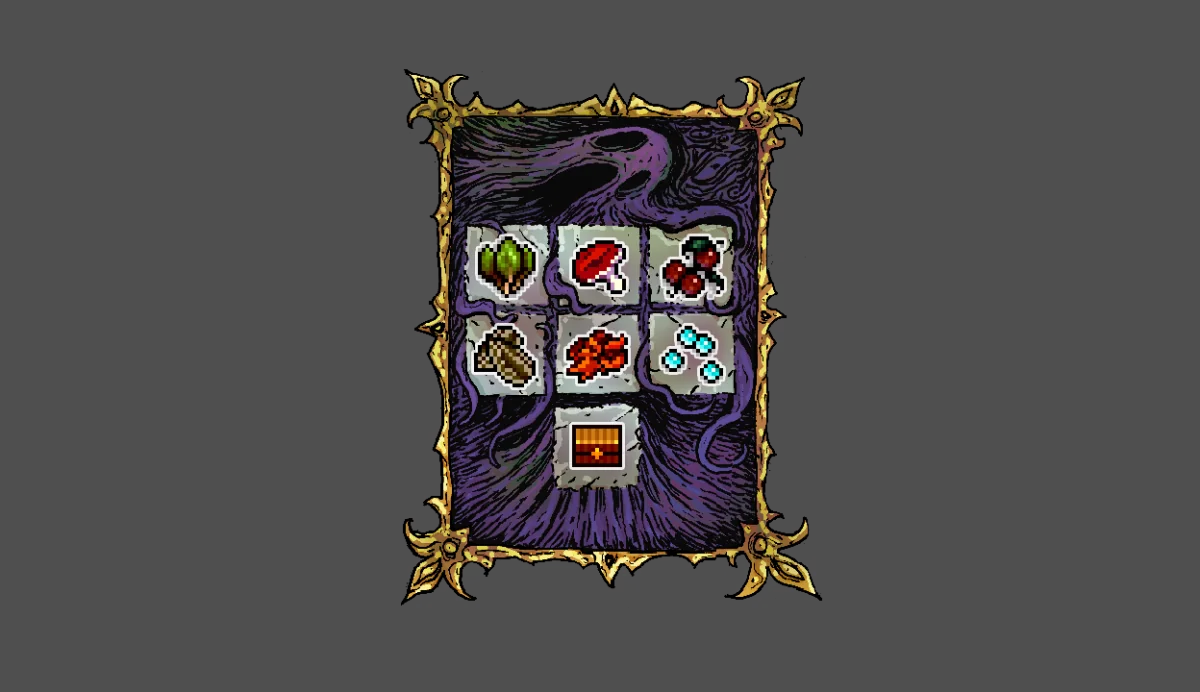
Foraging covers natural pickups such as herbs, fungi, and other resources found around the world. The forage catalog includes Bitter Herb, Red Mushroom, several wood materials, Old Woods mushrooms, and seasonal pickups such as Bloodberries, Dead Leaves, and Snow Pearls.
Each Foraging level adds one percentage point to double-forage chance. Numerical Luck is not part of that ordinary double-forage calculation. Forager's Luck, despite its name, is a separate named activity bonus.
A complete action-by-action XP table is not confirmed here. An item appearing in the forage catalog does not prove that every possible way of obtaining it awards Foraging XP. In particular, Wood being listed does not establish that every axe swing raises this skill.
Separate forage pickups from other resource methods
Elderfield supplies materials through several methods: mining, wood cutting, fishing, foraging, bug catching, monster drops, and exploration. These methods should not all be treated as a single Foraging category merely because they place materials into your inventory.
The useful distinction is the action and system involved. Picking a natural herb or mushroom is the core forage activity. Fishing has its own catch checks and skill. Monster items use encounter reward rules. Mining has its own ore and hazard calculations.
Bug catching deserves a separate distinction. Foraging level contributes to the quality calculation for ordinary spawned bugs, but that interaction does not make the bug's quality check identical to double-forage chance. The two calculations use different inputs and happen at different stages.
For the broader region containing many of the listed pickups, use the Old Woods guide. It handles access and other regional objectives; the tables here identify the resources relevant to Foraging.
Find common forage materials
| Item | Listed locations | Main listed use | Listed sale value |
|---|---|---|---|
| Bitter Herb | Town, Town Outskirts, Mall, Old Woods | Cooking ingredient; restores 2 HP when used | 4g |
| Red Mushroom | Town, Town Outskirts, Mall, Old Woods | Cooking and crafting ingredient | 6g |
| Wood | Town, Town Outskirts, Mall, Old Woods | Crafting; Furnace or Slicer processing | 4g |
| Hardwood | Farm, Old Woods | Crafting ingredient | 3g |
| Spiritwood | Farm, Old Woods | Crafting ingredient | 3g |
These are location listings, rather than a promise that each map contains every item on every visit. They do not establish an exact daily spawn count, an hourly reset timer, or a method for forcing a particular pickup to appear.
Bitter Herb's two-HP effect is a small direct restoration, distinct from whatever a recipe using the herb produces. For its specific collection and cooking uses, follow the Bitter Herb guide. This page uses it to identify a common forage item rather than repeating a full recipe route.
Red Mushroom is listed for cooking and crafting with a warning against eating it raw. The exact harmful outcome is not established in this catalog, so there is no verified damage figure to attach to that warning.
Wood, Hardwood, and Spiritwood are separate entries. Check the name required by your recipe or task rather than assuming that any of the three is interchangeable. Their presence in the catalog explains why “forage” is broader than edible plants, while leaving the exact XP behavior of every collection action unresolved.
Identify Old Woods mushrooms
The following mushrooms are listed as gatherable from Old Woods forage nodes in every season. Each is a crafting ingredient.
| Mushroom | Listed sale value | Identifying description |
|---|---|---|
| Spiritcap Mushroom | 15g | Slightly translucent; described as whistling faintly |
| Night-Hood Mushroom | 30g | Dark and bitter |
| Corpse-Ear Mushroom | 30g | Named for its resemblance to a drowned corpse's bloated ear |
| Ashy Mushroom | 30g | Brittle and crumbling |
| Golden Mushroom | 150g | Brightly glittering and valuable |
| Whisptop Mushroom | 30g | Light cap that flows like fabric |
| Bulbous Mushroom | 30g | Many folds; described as storing natural power |
| Dual-Sprout Mushroom | 30g | Two sprouts |
Golden Mushroom has a higher listed sale value than the other mushrooms in this table. That is a value comparison, not evidence that its spawn chance is higher, that its crafting role is always less useful, or that selling every one is the best progression choice.
The year-round availability statement applies to these Old Woods mushroom entries. It does not remove daily access conditions from every Old Woods clearing or guarantee a particular mushroom on each node.
Track seasonal and event pickups
The forage catalog also separates pickups by season. The item locations and uses below are confirmed, but their inclusion here does not establish a fixed number available each day.
Spring Bloodberries
Bloodberries are listed for Town and Town Outskirts during spring. They are a cooking ingredient with a listed sale value of 20g.
Their forage role is the gathered berry. This entry does not provide a planted-crop growth time, a seed shop unlock, or a recipe list. Avoid applying farming instructions to the pickup without a separate planted version being confirmed.
Summer Sunflower Seeds
Sunflower Seeds appear in the summer forage list for Town and Town Outskirts. They restore 10 HP and have a listed sale value of 18g.
The same item can also be planted in a Flower Bed around the Farmhouse. That planting entry gives a 12-day growth time and allows summer or autumn as planting seasons for a Tier 1 flower. A seed's planting season and its natural forage listing answer different questions: the autumn planting allowance does not itself prove that natural seed pickups appear throughout autumn.
Autumn Dead Leaves
Dead Leaves are listed in Town and Town Outskirts during autumn, with a 25g sale value. Their crafting description allows them in place of Bat Guano in recipes that accept that substitution.
That material substitution is their practical use beyond selling. The catalog does not enumerate every qualifying recipe, so do not assume that every recipe containing Bat Guano accepts an arbitrary replacement without checking the recipe itself.
Winter Snow Pearls
Snow Pearls are outdoor forage during Death, the winter season. Listed areas include Town, Lakefront, Mall Parking Lot, Town Outskirts, Pumpkin Path, and Greystone Estates, with other outdoor forage areas also noted.
They have a listed sale value of 10g and can be donated to the Art Gallery. The Art Gallery guide covers collection and donation requirements. A Snow Pearl's forage role does not establish that every winter collection item is found through the same method.
Event Gemflowers
A Gemflower gives assorted gems and is spawned by a News Event. It should be treated as an event pickup rather than a routine seasonal route. No fixed news schedule or guaranteed daily Gemflower is confirmed here.
Calculate the ordinary double-forage bonus
The ordinary double-forage calculation uses its base bonus, Foraging level, Forager's Luck, and Ring of Plenty. Numerical Luck and the five Luck tiers are not inputs to this particular calculation.
Every Foraging level adds one percentage point. Moving from level 4 to level 5 adds one point to this chance; it does not mean the entire current chance is multiplied by 1.01. The exact total still depends on the other applicable bonuses.
Forager's Luck is an activity-specific effect. Its name should not be read as an increase to the character's Luck stat for every system. Likewise, improving a Luck tier is not a confirmed substitute for raising Foraging level when the objective is ordinary doubled pickups.
The catalog does not supply every bonus amount or a full XP requirement table. There is no reliable basis here for promising a particular level after a specified number of pickups or quoting a universal double-forage total with unknown equipment and effects.
Understand the related bug-quality calculation
For ordinary spawned bugs, the quality chance starts at 15%, adds the Foraging level with a minimum contribution of one point, and receives five extra percentage points at Very Lucky. A current implementation issue means Lucky, Normal, Unlucky, and Very Unlucky do not apply their other intended tier adjustments to this check.
When the quality roll succeeds, the quality distribution is 70% silver, 20% gold, and 10% purple. These percentages belong to the successful quality branch. They are not the overall chance of catching a purple bug on every attempt.
The check occurs when the bug spawns, rather than when an already spawned bug is caught. Changing Luck after the bug is visible does not retroactively assign it a new quality. Luck also does not change the separate initial spawn-chance roll.
This is why bug quality and ordinary doubled forage should be kept separate. One uses a quality check at spawn and a currently limited Luck-tier adjustment. The other uses Foraging's double-pickup inputs without numerical Luck. The Luck guide covers the other activities affected by that stat and the broader tier-calculation warning.
Use the confirmed limits when planning a route
Choose a route around the item and season you need, rather than treating every natural pickup as an identical reward. Common herbs, wood materials, seasonal outdoor items, and Old Woods mushrooms have different locations and uses.
The missing details are precise XP awards per action, every item's spawn rate, and a universal refresh schedule. Those gaps prevent a guaranteed “collect this many nodes to gain a level” route. They do not prevent you from using the confirmed catalog to identify useful pickups, retain task materials, and distinguish Foraging bonuses from unrelated Luck calculations.
Editorial verification
This guide was source-checked on . Confirmed game details, community observations, older-build behavior, and unresolved evidence gaps are identified in the article instead of being presented as equally certain.
Found an outdated step or a version mismatch? Send a correction to Kevin.